
Throughout history, humans have expressed their observations, emotions, and curiosity through many forms of representation. This tradition extends back more than 40,000 years to cave sites such as Lascaux and Lubang Jeriji Saleh, where our ancestors depicted animals including aurochs, horses, and deer. As time passed, the ways we represent and interpret the world evolved, giving rise to an extraordinary range of artistic expression, from the refined compositions of Raphael to the bold experimentation of Jackson Pollock.
Until the 17th century, art and science were closely connected, each shaped by the limits of human perception. Long before the Renaissance, this unity was evident in practices such as ancient Greek anatomical study, medieval manuscript illumination, and the mathematical optics developed by thinkers like Ibn al-Haytham, all of which linked scientific inquiry with visual representation. The Renaissance later intensified this connection, as artists and scholars refined anatomical knowledge and formalized perspective geometry to understand and depict space more accurately. Science still relied on observing and classifying visible natural phenomena, and artists portrayed the world as it appeared to the eye. In the 17th century, however, a new phase began. The emergence of a new mode of production reshaped economic and intellectual life, creating demands for systematic inquiry, standardization, and technical innovation. Science became increasingly organized and ambitious, aided by instruments such as the telescope and the microscope, which expanded the boundaries of what could be observed and understood.
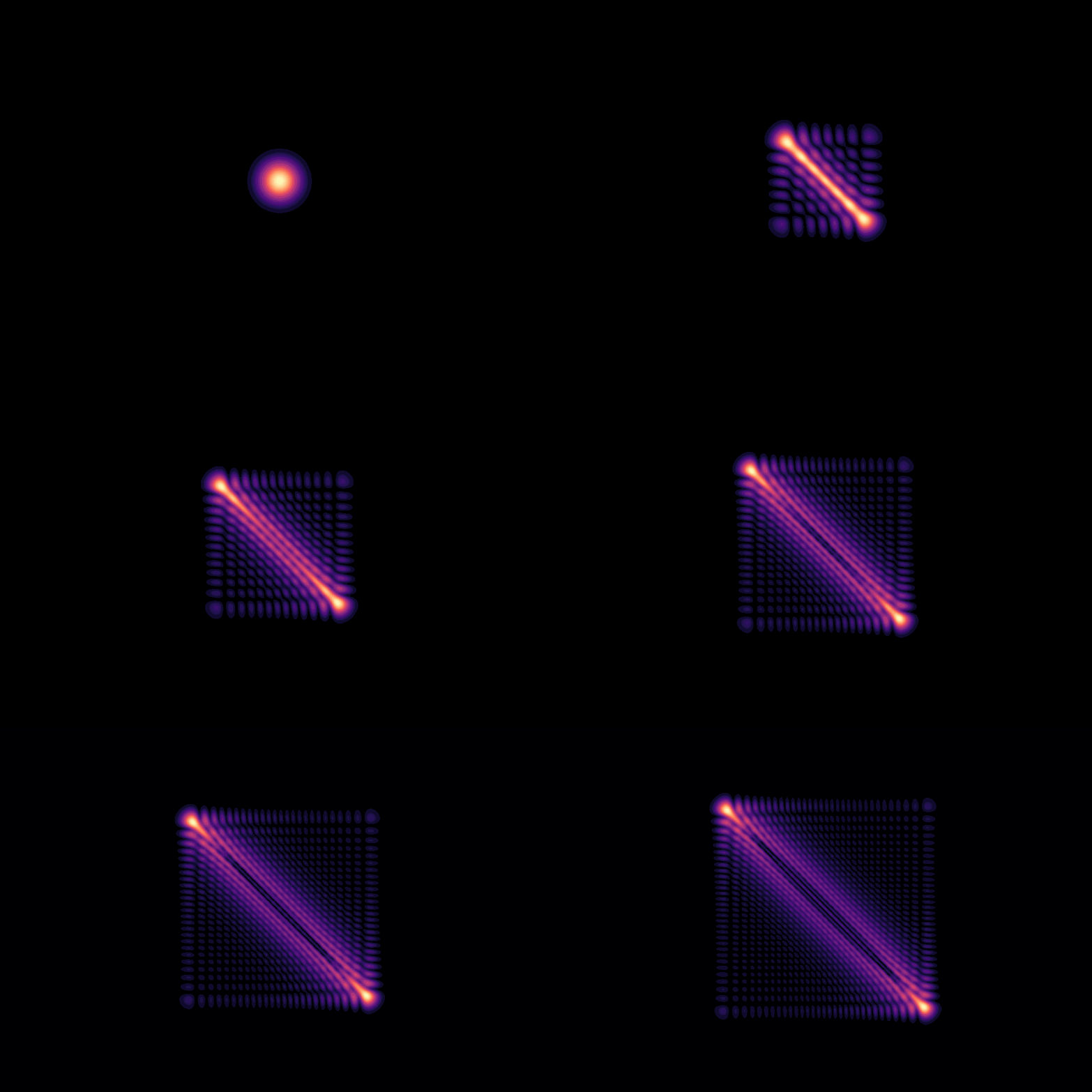
Since the 17th century, science has advanced at an extraordinary pace, opening access to realms ranging from cosmic scales to the quantum world. Art, however, has remained largely anchored in human perception, even when it embraced abstraction in movements such as Dadaism and Surrealism. Artists continued to depict visible or intuitively graspable forms—leaves, birds, stars—yet they could not directly portray realities that lie beyond sensory experience, such as quantum tunneling, curved spacetime, or the complex structure of the Riemann zeta function. Van Gogh’s intuitive rendering of turbulence in Starry Night stands as a rare instance where artistic vision brushed against phenomena later described mathematically.
In the age of AI, many assume that the long-standing gap between art and science can now be closed through AI-generated imagery. Digital tools have certainly expanded the possibilities for artistic production, yet they do not resolve the deeper divergence that emerged when science moved beyond the reach of human perception. AI, by its very nature, lacks the innate originality and conceptual intentionality that define human creativity. Because it can only recombine patterns drawn from its training data, AI-generated art tends to be repetitive and stylistically homogeneous, and it struggles to offer perspectives that are genuinely new rather than statistical variations on what already exists.
In an era dominated by superficial, pattern-based AI art, my aim is to reveal shapes, patterns, and phenomena grounded in real physics and mathematics, forms that emerge from the structure of the universe rather than from statistical remixing. By bringing these underlying realities into view, I hope to offer material that can inspire new artistic creation and enrich the expressive possibilities of scientific communication.
 enderalp.com